The ECHO Meeting. They pulled up the images of a patient with a mahooooosive post-MI right ventricular anuerysm with a laminar thrombus. She needs to get corrective surgery before her heart literally bursts. Or collapses from a stroke when that thrombus shoots up into her brain.
The Cardiology Patients. The consultant had a private patient admitted for shortness of breath. On examination, he had splinter haemorrhages on his nails, a ventricular heave, and tricuspid regurgitation (pan-systolic murmur loudest in the tricuspid region - and I identified it!). Later on, we were notified that the patient had deteriorated and had become dyspnoeic and anuric with an ABG lactate of 6. I watched as the consultant immediately ran off to make sure his rich little private patient didn't crash and die on him.
The Catheter Lab. Angiograms, where contrast is injected into the chambers of the heart and its own blood supply. Isn't it weird to think that the heart needs to pump blood to itself too? I watched as the coronary arteries filled to outline the shape of the heart, while the ventricle pumped out blood in real time. Then the insertion of a dual-chamber pacemaker. When checking for stabilisation, the doctors asked the patient on the operating table to cough. Turns out the patient was fully conscious despite having electric wires were being twisted into his heart muscle.
The science of the heart is remarkably straightforward - a muscular pump that pushes blood throughout your body. We take it for granted that it functions perfectly, but we forget that with each heartbeat, things could go terribly wrong.
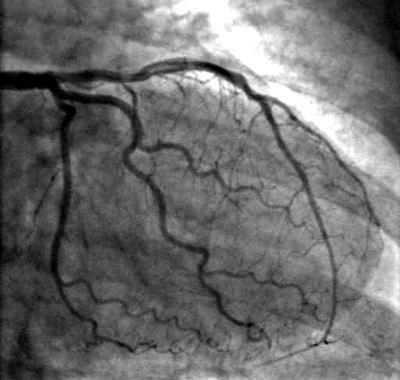
A coronary angiogram

No comments:
Post a Comment